

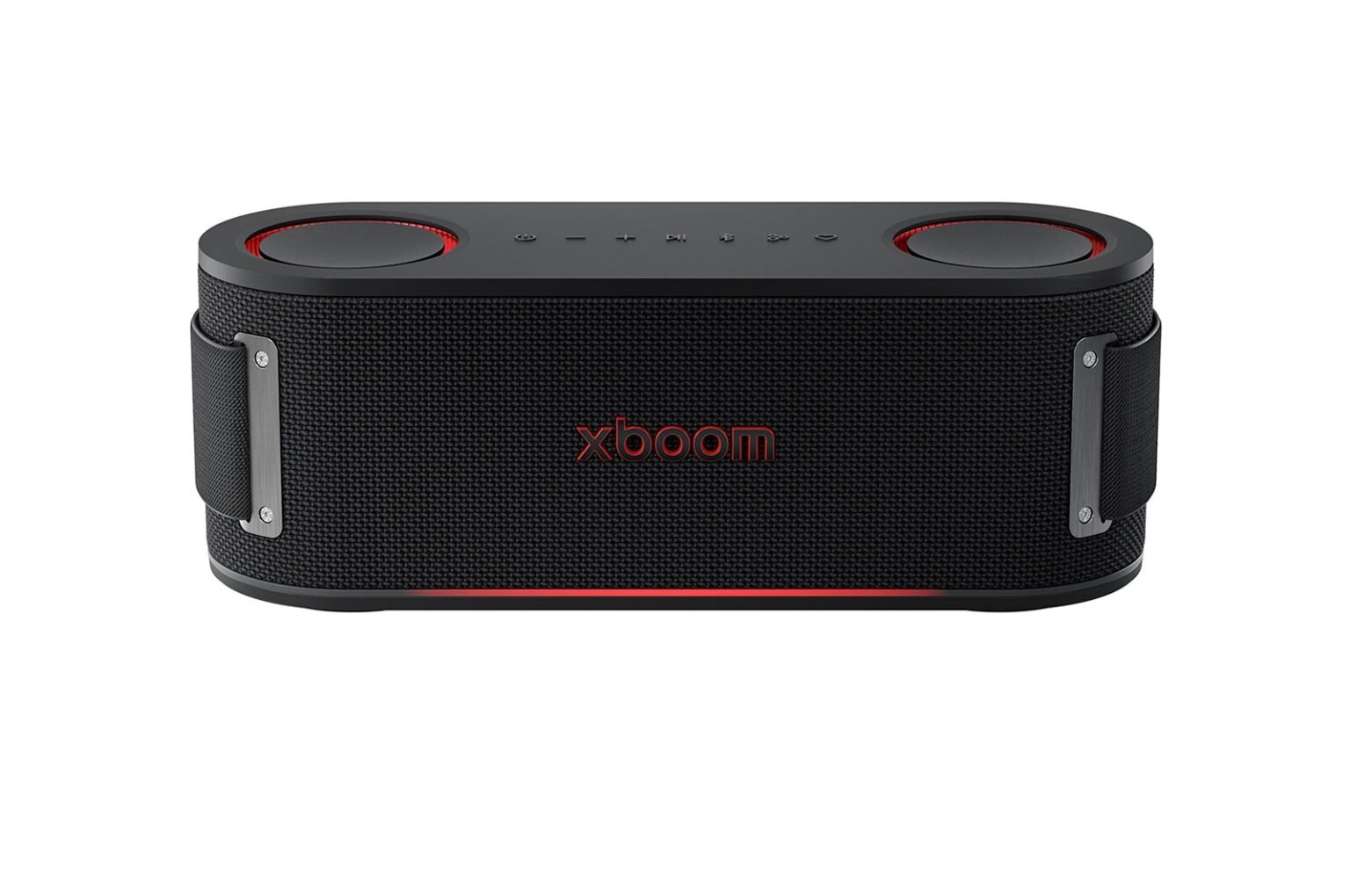

The LG XBoom Bounce arrived as the centrepiece of LG’s redesigned xboom lineup — a trio of speakers (the Grab, Bounce, and Stage 301) developed in collaboration with Grammy-winning artist and tech entrepreneur will.i.am. His role goes beyond the typical celebrity endorsement: appointed as LG’s “Experiential Architect” for the xboom brand, will.i.am personally tuned the audio signature of the Bounce, directed its Sound UI, and co-developed the FYI RAiDiO AI-powered streaming experience.
The Bounce is the mid-tier model, sitting between the compact XBoom Grab and the high-output Stage 301. At AED 699, it positions itself in one of the most competitive segments in consumer audio. What it brings to that fight is a distinctive racetrack form factor, dual passive radiators that physically bounce with the bass, a 40W total output, military-grade certification, IP67 water resistance, and a 30-hour battery. The question is whether the sum is greater than the very impressive-sounding parts.
Design
The XBoom Bounce does not look like other speakers. The racetrack-oval enclosure is immediately recognisable — wider than it is tall, with dual passive radiators sitting on the top face that visually (and physically) pulse with the low end as music plays. The effect is part gimmick, part genuine visual spectacle, and it earns its name. At a party or barbecue, this speaker draws a lot of attention.
The front face carries a subtle, continuous light bar — the AI Lighting strip — that shifts colour and rhythm in response to the music being played. Three modes are available: Ambient (steady atmospheric glow), Party (dynamic colour sync with beat detection), and Voice (responsive to speech). Status indicators are integrated into the same lighting system, so the speaker communicates its state visually rather than through a separate LED array. It is an elegant integration that gives the Bounce personality without the garish excess of some party speakers.

The carrying strap is a new addition to the xboom lineup. Made from an elasticised material, it wraps around the body and allows the Bounce to be slung over a wrist, arm, or attached to a bag. It works in practice, though it is more comfortable for short carries than extended hikes — the 1.42 kg weight makes itself known on longer trips. The strap also adds a distinctive visual character that makes the speaker look as much like an accessory as an audio device, which fits the will.i.am aesthetic well.
Controls are arranged on the top face, slightly raised for tactile operation. The layout includes power, volume, Bluetooth pairing, Party Link (for connecting multiple xboom speakers), an Auracast button, and the distinctive heart-shaped My Button. None of the controls are backlit, which becomes a minor frustration in low-light outdoor settings.
The My Button is programmable via the LG ThinQ app and provides one-touch access to FYI RAiDiO, Apple Music, or a custom playlist — a useful shortcut that becomes more valuable as you invest in the ecosystem.
Build Quality
The XBoom Bounce is built to outlast the occasions it is designed for. LG has pursued MIL-STD-810H certification — the U.S. military durability standard — testing the speaker across seven conditions: rain, vibration, impact, salt water spray, flooding, sand and dust exposure, and high temperature. This is not just a marketing badge; it represents rigorous independent verification of the speaker’s ability to withstand the conditions that typically kill portable audio equipment.
Complementing the military certification is an IP67 rating for water and dust resistance. IP67 means complete protection against dust ingress and immunity to immersion in up to one metre of water for thirty minutes. A pool party, a beach bash, a sudden downpour at a garden gathering — none of these represent a threat to the Bounce. The rubbered, sealed construction feels solid in the hand, with no flex or creak in the enclosure under pressure.=
At 1.42 kg, the Bounce is heavier than most of its competitors. The additional weight is partly a consequence of the larger driver and radiator configuration, partly the battery capacity, and partly the military-grade construction materials. It is not designed for ultralight backpacking — it is designed for the kind of adventures where you want the speaker to survive whatever happens to it.
The battery is notably user-replaceable — a genuine rarity in this product category and a meaningful long-term value proposition. Replacement batteries are sold separately and can be swapped using basic tools without requiring a service centre visit. For a device built to last outdoors, this extends the product’s usable lifetime considerably.

Connectivity
The XBoom Bounce uses Bluetooth 5.4 — the most current version of the standard at launch, offering improved connection stability, lower power consumption, and reduced latency compared to earlier iterations. Multipoint connectivity allows the speaker to be paired with two devices simultaneously, enabling seamless switching between a phone and a laptop without the need to unpair and re-pair.
Auracast (LE Audio broadcast) support is a forward-looking addition. By pressing the dedicated Auracast button, the Bounce can broadcast audio to any Auracast-compatible device, enabling shared listening experiences or synchronised multi-room audio. Party Link, the practical adjacent feature, connects multiple xboom 2025 speakers in either dual mode (two speakers for enhanced stereo) or multi mode (multiple speakers for distributed audio). Dual stereo pairing requires two identical Bounce units; multi-mode supports mixing across the Bounce, Grab, and Stage 301. This is consistent with the standard approach across the industry.
The supported audio codecs are SBC and AAC. The absence of aptX, LDAC, or aptX HD means the Bounce does not target audiophile-grade wireless fidelity — it prioritises broad device compatibility over high-resolution wireless audio. For most users playing music via Spotify or Apple Music, the difference is academic. For hi-res listeners with capable source devices, it is a minor limitation.
Voice assistant support covers both Google Assistant and Siri, accessible via the speakerphone function. The built-in microphone array is capable enough for calls and voice commands at moderate distances. Firmware updates are delivered over-the-air (FOTA), meaning the Bounce can receive new features and fixes without a wired connection to a computer.
Power is handled entirely via USB-C, which also provides a DC output function — the Bounce can be used to charge other devices. No auxiliary input is provided. The LG ThinQ app (available for Android and iOS) is required to access the full feature set, including EQ customisation, Auracast setup, lighting controls, and My Button configuration.
Sound Quality
The XBoom Bounce delivers 40W of total output — 30W through the woofer and 5W each through a pair of Peerless dome tweeters. Peerless is a century-old Danish audio component manufacturer with a genuine pedigree in high-end transducer design, and their involvement in the Bounce is a meaningful differentiator from competitors using generic driver assemblies. The dual upward-firing passive radiators add low-frequency extension and the physical bounce effect that gives the speaker its name.
At moderate to high volumes, the Bounce projects sound with real authority for its size. The low end is full and present, with a clear bias toward bass energy that suits electronic music, hip-hop, and genres where kick drum and bassline are the primary rhythmic drivers. The passive radiators are genuinely effective at extending the perceived bass response beyond what the 93mm woofer alone would deliver.
The Peerless tweeters bring meaningful high-frequency definition to the top end — cymbals and acoustic guitar strings have more air and presence than competing speakers in this price range that rely on generic dome tweeters. Where the sound profile shows its limitations is in the midrange: vocal clarity, while better than many bass-forward party speakers, can become slightly congested at peak volumes, and counter-harmonies in dense mixes are occasionally compressed behind the more dominant low-end response.

AI Sound mode is the most effective way to experience the Bounce. It analyses the audio being played in real time and adjusts equalisation to suit the detected genre. In practice, this produces a more balanced, genre-appropriate presentation than the Standard preset — acoustic music opens up, electronic music gains tightness in the sub-bass, and vocal-led tracks see improved intelligibility. The Bass Boost preset adds a modest low-frequency lift rather than a dramatic push, which is actually more useful than an aggressive boost at normal listening volumes.
Voice Enhance mode is optimised for speech clarity at the expense of musical fidelity and is best reserved for podcast or call use. The 6-band custom EQ available in the LG ThinQ app provides granular control for users who want to move beyond presets. Once configured to taste — typically involving a slight mid-frequency lift to balance the natural low-end bias — the Bounce delivers a more rounded, detailed presentation that compares more favourably with competitors like the JBL Xtreme 4 and Bose SoundLink Max.
Space Calibration, an AI-driven room analysis feature, adjusts output levels based on the size and layout of the listening environment. In practice, the difference between calibrated and uncalibrated sound is subtle but perceptible — primarily in the perception of reverb and room fill at higher volumes. It performs better in smaller, defined spaces (a living room, a covered patio) than in open outdoor environments.
Battery Life
LG rates the XBoom Bounce at up to 30 hours of playback — a figure measured at 50% volume with Bluetooth and Voice Enhance mode on, and with the lighting disabled. In real-world conditions at moderate-to-high volumes with AI Lighting active, expect something closer to 18–22 hours, which is still highly competitive in this product class.
The Bounce comfortably outlasts most of its closest rivals. For a full day of outdoor use — a long barbecue, a beach day, an evening gathering that extends past midnight — a single charge is sufficient without needing to manage power carefully. Charging to full takes approximately 3 hours via USB-C, which is reasonable for the battery capacity involved. The USB-C port also supports DC output, meaning the Bounce can serve as a portable power bank for charging phones or other small devices — useful insurance on outdoor trips where power sources are scarce.
The user-replaceable battery is worth re-emphasising in this context. Most competing speakers of this quality level are sealed units whose battery degradation over time represents a terminal condition for the hardware. The Bounce’s serviceability means that when the battery eventually degrades to a point where runtime becomes unacceptable (typically after two to four years of regular use), the speaker can be restored to full performance with a replacement cell rather than replaced entirely.
Performance
The XBoom Bounce performs as a system with more interconnected parts than a typical portable speaker, and the overall experience depends significantly on how much of that system the user engages with. At its most basic — Bluetooth pairing and press play — it is a loud, bass-present speaker that does the job without drama. With the ThinQ app configured, AI Sound active, and the lighting and My Button set up, it becomes a more comprehensive entertainment device with genuine personality.
The AI Sound engine is responsive and consistent. Genre detection is fast — switching from a classical track to an electronic one produces a perceptible EQ adjustment within a few seconds. The system does not claim perfection: genre boundaries are sometimes ambiguous, and the AI occasionally misclassifies spoken-word content as music with mildly inconvenient results. Manually selecting a mode is always available as an override.
The AI Lighting is one of the Bounce’s more distinctive performance elements. Beat-sync accuracy in Party mode is genuinely impressive, with the light bar tracking rhythmic patterns rather than just average amplitude. It transforms the speaker from an audio device into part of the ambient environment at gatherings. The integration with the music, tuned by will.i.am’s direction, gives the lighting a sense of intention that distinguishes it from the generic colour-cycling effects on many competing party speakers.
The FYI RAiDiO feature — will.i.am’s AI-powered radio platform — is accessible via the My Button and delivers interest-based audio stations fronted by AI DJ personas with distinct cultural characters. It is more developed than most manufacturer-bundled streaming features and adds genuine content value to the ecosystem. It requires both the LG ThinQ and FYI apps to be installed and configured, which is an additional onboarding step but a one-time investment.
Verdict
The LG XBoom Bounce is a speaker that rewards the right user and the right context. It is emphatically not a speaker for the listener who wants to sit quietly and hear the finest possible audio detail — for that, the money stretches further with multiple options available on the market. What it is, and what it does better than almost anything else in this price bracket, is deliver a complete party and outdoor entertainment experience: loud, visually engaging, physically durable, and enduring enough to outlast the occasion.
The will.i.am collaboration has produced more than a badge on the box. The audio tuning is identifiable — warmer, with more low-end character than LG’s previous xboom products — and the Sound UI won a Red Dot Award for legitimate reasons. AI Sound mode is genuinely useful rather than a feature list checkbox, and the Peerless dome tweeters give the high end more presence than the price point typically delivers.
The military-grade durability, IP67 protection, replaceable battery, 30-hour runtime, and the sheer entertainment ecosystem around the device — AI lighting, FYI RAiDiO, Auracast, Party Link — make the Bounce a more considered product than its party-speaker framing might suggest. It is built to be owned for years, taken everywhere, and upgraded alongside the xboom ecosystem as it grows.
For the buyer who wants a speaker that can handle anything, sounds great at volume, and becomes the centrepiece of wherever they take it — the XBoom Bounce earns its place.
Price: ₹ 29,051
Our Verdict: ★★★★☆
