

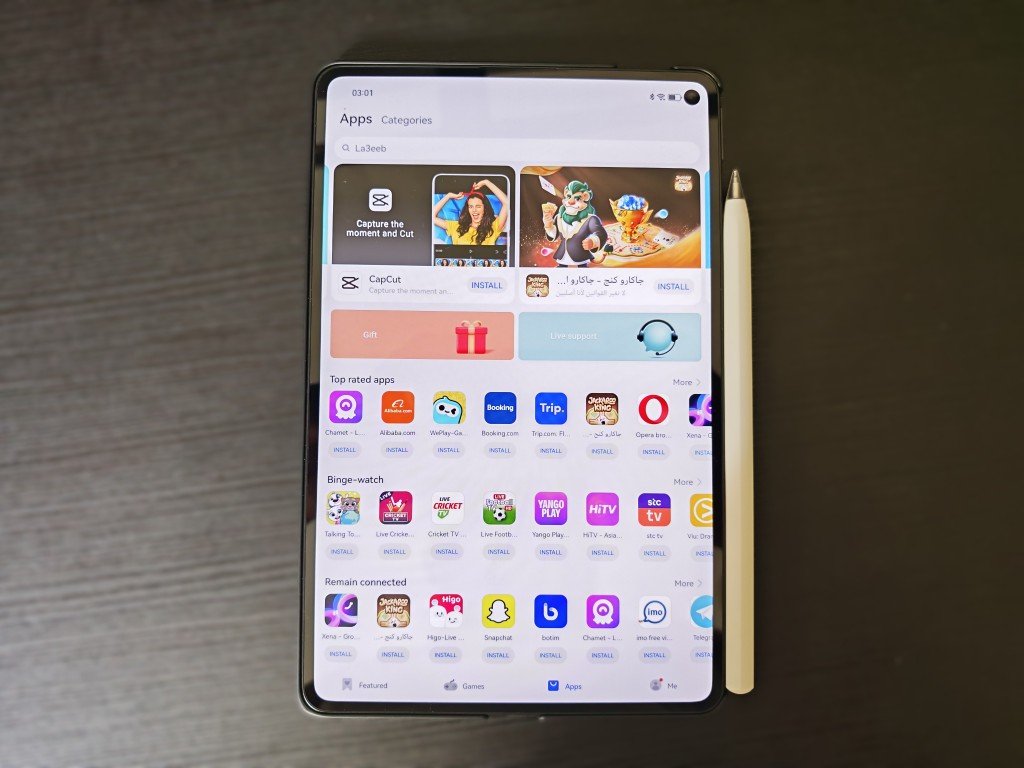

When Huawei announced the MatePad Mini in September 2025, it wasn’t just launching a tablet — it was making a statement. At 5.1 mm thin and 255 grams, it is the thinnest and lightest tablet over 8 inches ever made at the time of its release. The standard (non-PaperMatte) edition reviewed here carries an 8.8-inch flexible OLED FullView Display, a 50 MP + 8 MP rear camera system, a 32 MP front camera, 66 W SuperCharge, and runs HarmonyOS 4.3.
Design and Build Quality
Holding the MatePad Mini for the first time produces a reaction that is difficult to rationalise. It feels like a premium hardback book that someone has somehow made thinner than a pencil. The 5.1 mm chassis and 255 g weight are not just marketing numbers — they are physically noticeable compared to every other tablet in this size bracket.
The construction pairs a 3D vegan fibre back panel with a magnesium alloy frame. The back has a subtly textured feel that resists fingerprints reasonably well, while the frame gives the device a solid, non-flex rigidity that does not feel hollow or brittle. The Star Ring design around the camera module and the precision-machined rotating bezel give the device visual character beyond the typical slab aesthetic. Two colours are available in the global edition: Spruce Green and Graphite Black — both understated and confident rather than showy.

The power button on the top edge doubles as a fingerprint sensor, and it is accurate and fast. There is a USB-C port on the bottom, two speaker grilles, and a microphone. The overall build resists torsion impressively for its thinness. Nano-injection moulding at the frame joints and micro-arc edge treatment give the chassis a 30% improvement in drop resistance over comparable ultra-slim designs, addressing a concern that historically came with the territory of sub-6 mm tablets. This is possibly the best-designed compact tablet currently available.
Display
The standard MatePad Mini uses a flexible OLED FullView Display — not the PaperMatte Edition’s anti-glare optical film variant, but the base OLED panel underneath, which is arguably the more vibrant of the two. The difference between the two editions is meaningful: the PaperMatte adds a diffusion layer that softens reflections and mimics a paper-like texture, at the cost of some peak vibrancy and pixel sharpness. The standard edition forgoes all of that for a display that is unapologetically saturated and brilliant.
The numbers are strong: 2560 x 1600 resolution at 343 PPI, a 120 Hz adaptive refresh rate, up to 1800 nits peak brightness, a 2,000,000:1 contrast ratio, P3 wide colour gamut with 1.07 billion colours, and a screen-to-body ratio of 92% with bezels measuring just 2.99 mm. Professional colour accuracy reaches ΔE < 1, which is a figure typically reserved for creator-grade monitors. HDR Vivid certification rounds out the credentials.

In use, the display is one of the finest 8-inch-class screens available at any price. Colours are rich and deep without tipping into oversaturation. Black levels are absolute — as expected of OLED — and shadow detail in dark content is excellent. The 120 Hz refresh makes scrolling and animation feel fluid and immediate. Outdoor use in direct sunlight is where the lack of the PaperMatte film is felt: the glossy OLED panel catches reflections more readily than the PaperMatte edition, and while the 1800 nit ceiling largely compensates, working under bright light for extended periods is more fatiguing on the standard model.
Eye comfort tools are present — a blue light filter (Eye Comfort mode) and a monochrome eBook mode — though the standard edition lacks the hardware-level paper texture that makes the PaperMatte particularly well-suited to prolonged reading. For video consumption, creative work, and general use, the standard display is outright better. For document reading in mixed lighting, the PaperMatte has the edge.
Performance
The MatePad Mini is powered by the Kirin 9010 processor — Huawei’s in-house chip on a 4 nm process, featuring a two-cluster architecture with high-performance and efficiency cores. Day-to-day performance is consistently smooth. Apps open without hesitation, system animations run with no visible stuttering, and split-screen multitasking between two apps — say, HUAWEI Notes and a browser — works without any perceptible slowdown.
The 8 GB and 12 GB RAM configurations both manage memory competently under typical workloads. Where the Kirin 9010 distinguishes itself is thermal management. Huawei has implemented a 3D heat dissipation architecture that distributes thermal load across both the rear cover and the display panel, allowing the device to maintain sustained performance under load without the throttling that afflicts thinner tablets. During extended video playback, creative work in GoPaint, or prolonged document editing sessions, the device remains cool to the touch and performance stays consistent.

For the productivity, creative, and media consumption workloads it is designed for, it handles everything thrown at it without complaint. The Maleoon GPU handles visually demanding UI effects and graphics-intensive apps in the Huawei ecosystem without issue.
Stylus Support
The HUAWEI M-Pencil Pro is sold separately but is central to the MatePad Mini experience. It connects via NearLink (Huawei’s low-latency wireless protocol) and achieves a stylus-to-screen latency of 2 ms — a figure that places it among the most responsive stylus implementations available across any platform.
The M-Pencil Pro introduces several hardware-level gestures not found on competing styluses: a pinch gesture activates a radial menu of tools, rotation of the barrel adjusts brush stroke width in compatible apps, and a quick-access button launches a user-defined application instantly. Three interchangeable tips are included — standard, fine, and felt-tip — each offering a different tactile feel for different workflows.
In HUAWEI Notes, handwriting is enhanced through AI: a lasso tool selects handwritten text and converts it to a chosen font while preserving layout, and handwritten equations can be circled to be digitised and solved automatically. These are not gimmicks — both features work reliably and meaningfully accelerate note-taking in academic or professional contexts.
GoPaint, Huawei’s built-in illustration app, supports the full feature set of the M-Pencil Pro and offers a brush library and blending engine that comfortably rivals premium third-party drawing apps. The combination of 2 ms latency, interchangeable tips, and a fully featured drawing application makes the MatePad Mini a serious tool for digital artists and illustrators who do not require the larger canvas of a 12-inch tablet.

The Folio Cover accessory provides integrated stylus storage and a protective stand, and is a recommended companion purchase given the M-Pencil Pro lacks a built-in magnetic attachment point on the standard edition.
Software and HarmonyOS Features
The global MatePad Mini ships with HarmonyOS 4.3 — a mature, polished OS that bears strong visual and gestural similarities to both iOS and Android but is, underneath, an entirely Huawei-native platform. The interface is clean and responsive, with a customisable home screen, a refined notification system, and a control centre layout that will feel intuitive to anyone who has used a modern tablet.
Multitasking is a standout strength. The floating window system allows apps to run in adjustable overlays above the main view, and split-screen enables two full-sized apps side by side. Drag-and-drop works across apps for files, images, and text. Quick Notes allows immediate capture of handwritten or typed notes from any screen state with a gesture. The task sidebar provides persistent access to frequently used apps without switching context.
The Super Device ecosystem integration is genuinely useful for those with other Huawei hardware. Multi-screen Collaboration allows the tablet to act as a secondary display for a Huawei MateBook, with shared clipboard and file drag-and-drop across devices. Multi-Window for cross-device interactions is smooth in practice.
Camera
The MatePad Mini carries a dual rear camera system — a 50 MP main sensor at f/1.8 and an 8 MP ultra-wide macro camera at f/2.2 — alongside a 32 MP front camera at f/2.4. These are, by any tablet standard, impressive specifications. The 50 MP main camera captures up to 8192 x 6144 pixels in high-resolution mode and supports 4K video recording at up to 3840 x 2160 with electronic image stabilisation.

In daylight and well-lit indoor conditions, the main camera produces images with genuine detail, accurate colour rendering, and solid dynamic range. It outperforms every competing compact tablet camera in resolution and low-light capability.
The 8 MP ultra-wide doubles as a macro camera, a combination that makes it versatile beyond the typical secondary sensor role — useful for document scanning, product shots, and close-up detail work as well as environment and group photography. The 32 MP front camera is the standout. It supports RAW portrait capture and adapts well to variable lighting, making video calls, live streaming, and self-documentation distinctly better than the face camera experience on comparable tablets. Auto-framing during video calls uses the front camera intelligently to keep subjects centered.
Battery and Charging
The MatePad Mini houses a 6,400 mAh battery (6,350 mAh rated capacity) — a significant capacity for a tablet this thin, and particularly remarkable given the 5.1 mm chassis. Battery life in mixed use — browsing, video streaming at moderate brightness, notes, and light creative work — comfortably exceeds a full working day on a single charge. For video-focused use, expect eight to ten hours before needing to reach for the charger.
A 66 W HUAWEI SuperCharge is included in the box, alongside the charger and cable. The 66 W charging speed is exceptional for a tablet: 30 minutes of charging delivers approximately 60% battery, and a full 0–100% charge completes in roughly 75–80 minutes. This brings the MatePad Mini into smartphone-grade charging territory — a meaningful quality-of-life advantage over competing tablets that top out at 20–30 W.
Huawei’s smart power conservation technology maintains battery health over a three-year standby cycle, meaning the battery retains capacity even after extended periods without use. Long-term battery degradation is a more serious concern on thinner devices where battery size is constrained by thermal management, but Huawei’s intelligent charging management (which learns usage patterns and delays full charge to reduce cell stress) mitigates this meaningfully.
Overall Productivity
The MatePad Mini occupies an interesting space in the productivity landscape. It is not trying to replace a laptop — the 8.8-inch screen, while excellent, is too small for extended multi-window office work, and there is no keyboard cover option tailored specifically to this model. What it does exceptionally well is serve as the ideal companion device: the go-anywhere, carry-everywhere tablet that handles the light-to-medium productivity tasks that come up between desk sessions.
Reading and annotating PDFs with the M-Pencil Pro is genuinely better on this device than on a phone and more portable than a 12-inch tablet. Taking handwritten notes in meetings, reviewing documents, video calling, managing email and calendar, and accessing cloud-stored files through HarmonyOS’s file management system all work cleanly and efficiently. The Super Device ecosystem means that content started on a Huawei phone or MateBook transitions to the tablet without friction.
For content creators — specifically illustrators, digital artists, and note-heavy learners — the combination of the M-Pencil Pro’s 2 ms latency, GoPaint, HUAWEI Notes, and the OLED display creates a workflow environment that meaningfully competes with the iPad mini as a creative tool.
Overall Performance
The MatePad Mini delivers a unified, premium experience that is more than the sum of its individual scores. The Kirin 9010 chip is not the fastest processor available in a compact tablet, but it is matched to the device’s purpose with enough overhead to handle everything the target user will throw at it. There is no meaningful scenario, within the device’s intended use cases, where performance feels limiting.
System smoothness at 120 Hz is consistent. App switching is instant. Creative and writing tasks, where sustained performance over hours matters, benefit from the thermal management architecture that keeps the device cool and the processor unconstrained. Wi-Fi 7 support with smart antenna technology ensures network performance is not degraded by how the device is held, which is a genuine hardware innovation for a device used frequently one-handed. Bluetooth 5.2 with LDAC and L2HC support means audio quality through wireless headphones is excellent.
Fingerprint authentication via the side-mounted power button is fast and accurate. GPS and multi-constellation positioning (GPS, GLONASS, BeiDou, Galileo, QZSS) give the device real-world navigation utility in the optional cellular configuration.
Verdict
The HUAWEI MatePad Mini (standard edition) is the most compelling compact tablet not made by Apple. Its hardware is, in several dimensions, superior to the iPad mini: it is thinner, lighter, has a larger screen, a better front camera, faster charging, a more sophisticated stylus, and a more innovative design. The OLED display, even without the PaperMatte film, is reference-grade in colour accuracy and brightness.
The HUAWEI MatePad Mini’s standard edition is the right choice for anyone prioritising video consumption, creative work, and visual quality over extended paper-textured reading. It is a more vivid, more brilliant display for most use cases. For what it is — a premium, portable creative and productivity companion with an extraordinary display and best-in-class stylus — the MatePad Mini standard edition is exceptional.
Price: Rs. 38,500 onwards
Our Verdict: ★★★★☆
